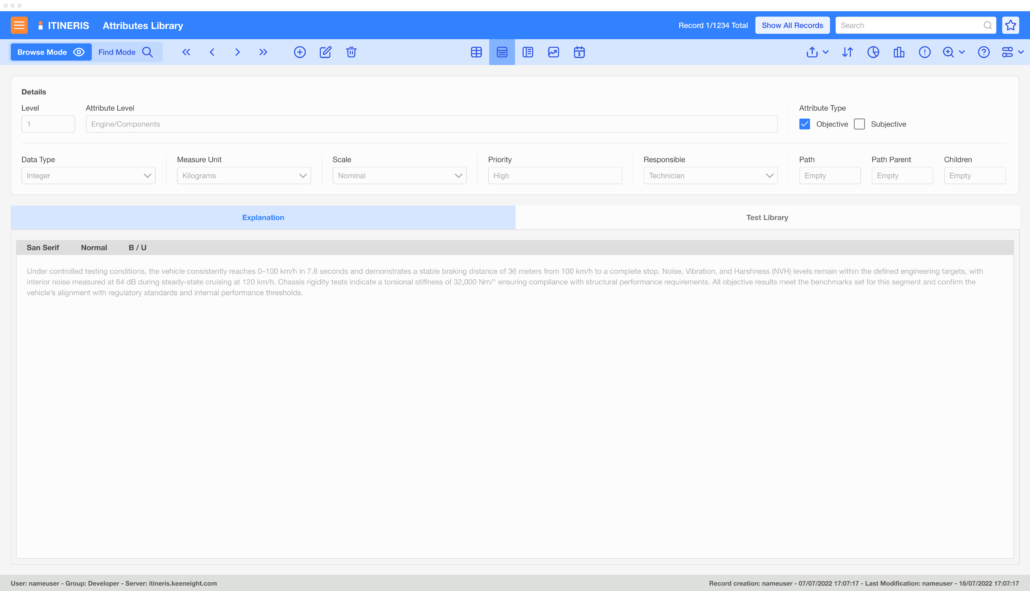
Objective Attributes
Objective attributes are measurable and quantifiable characteristics of a vehicle or its components, evaluated using standardized tools, procedures, and metrics. These attributes are critical for ensuring consistent, unbiased assessments of a vehicle’s performance, quality, and compliance. They serve as the foundation for data-driven decision-making in automotive development, enabling teams to make factual comparisons and track progress toward project goals.
By focusing on objective attributes, the Itineris platform enables a rigorous and data-centric approach to automotive development, ensuring products meet performance standards, customer expectations, and regulatory requirements.
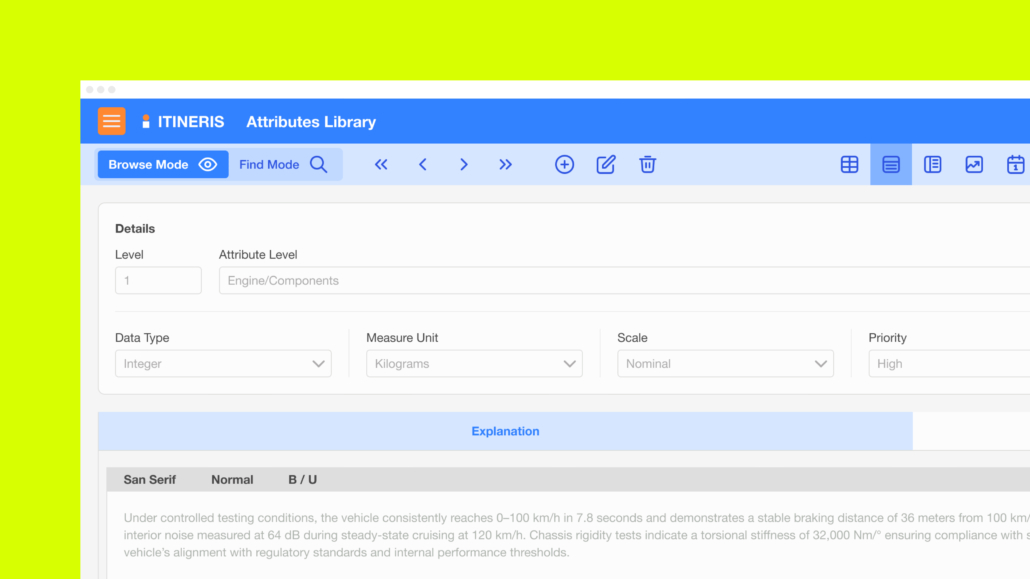
Key Features
1. Measurable and Standardized:
- Objective attributes are defined by specific, quantifiable parameters such as acceleration, braking distance, fuel efficiency, emissions levels, NVH (Noise, Vibration, and Harshness), and aerodynamics.
- Measurements are obtained using precise instruments and methodologies to ensure consistency and repeatability.
2. Data-Driven Evaluations:
- These attributes eliminate personal bias, providing factual data that allows for fair comparisons between vehicles, configurations, or competitive models.
-
Engineering teams use this data to validate designs, refine performance, and meet regulatory standards.
3. Integration with Itineris Modules:
- Target Settings Module: Objective attributes are key inputs for defining project targets, ensuring alignment with customer expectations, performance benchmarks, and regulatory requirements.
- Test Library: Attributes form a core component of the Test Library, guiding the creation of standardized tests for evaluating performance and quality.
- Design Verification Plan (DVP): Objective attributes are validated through DVP testing, ensuring that all design elements meet the predefined criteria.
- ssue Tracker: Attributes are monitored for deviations or non-conformities during testing and development, with issues logged and tracked for resolution.
4. Comparison and Benchmarking:
- Enables direct comparisons between different vehicle models, configurations, or competitive benchmarks, supporting continuous improvement and market positioning.
5. Support for Advanced Analysis:
- Allows teams to perform “what-if” analyses by modeling how changes to design or components impact objective attributes, guiding informed design decisions.

Benefits
- Consistency in Evaluation: Standardized measurement methods ensure uniformity across tests and projects, enabling reliable comparisons.
- Enhanced Decision-Making: Data-driven insights from objective attributes help teams prioritize improvements and allocate resources effectively.
- Alignment with Targets: Directly tied to project goals, objective attributes provide clear metrics for tracking progress and achieving performance benchmarks.
- Regulatory Compliance: Ensures that vehicles meet measurable standards required by local and international regulations.
- Collaboration Across Teams: By integrating with various Itineris modules, objective attributes create a unified framework for teams to collaborate on achieving quality and performance goals.