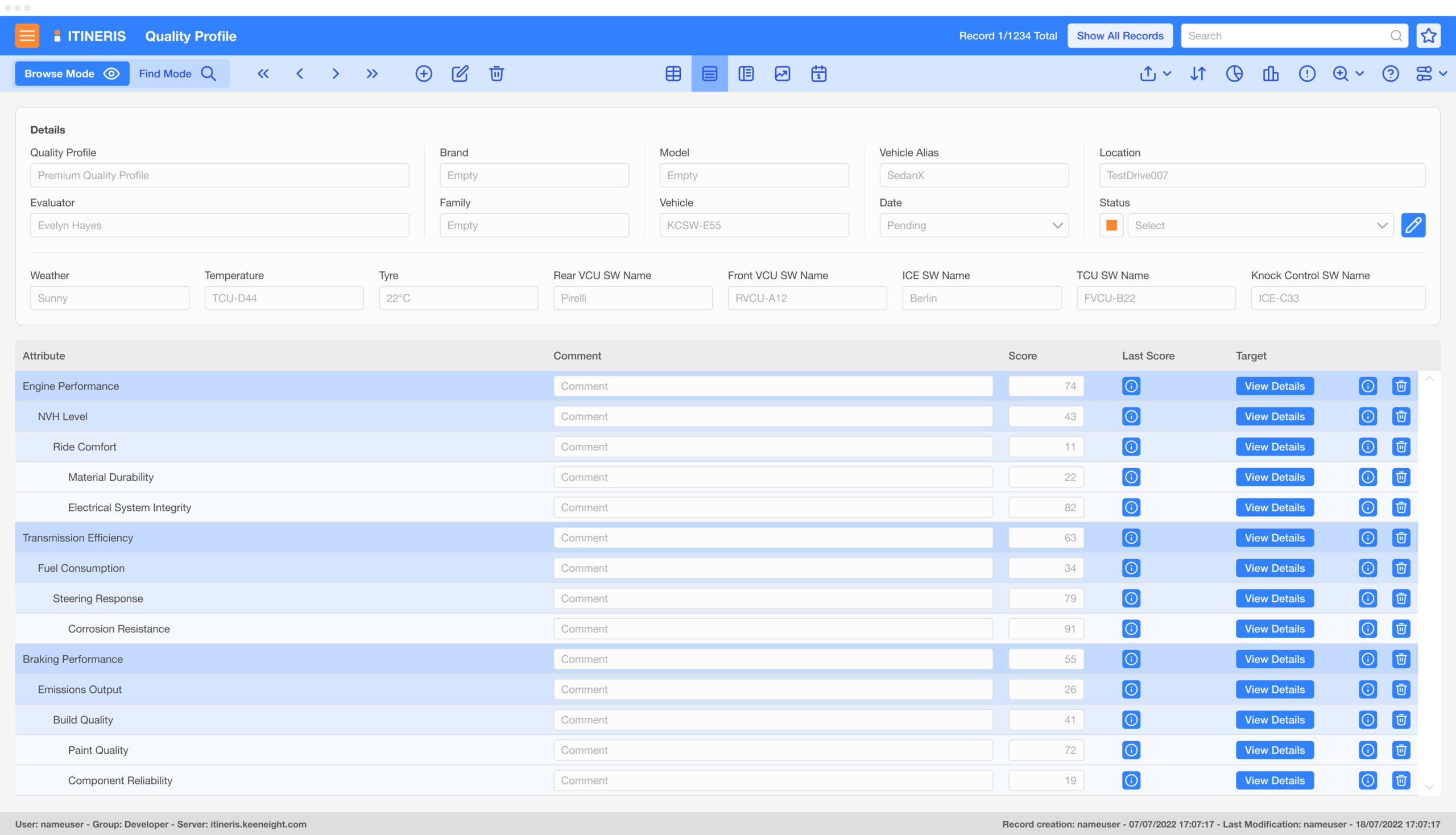
Quality Profiles
The Itineris Quality Profiles module is a comprehensive solution for capturing, managing, and analyzing subjective evaluations of vehicle attributes. Designed to assess how vehicles are perceived by various stakeholders, it ensures that both technical performance and customer satisfaction are addressed throughout the development and testing process. The module provides a structured, data-driven approach to subjective assessments, making it an essential tool for aligning product design with user expectations and market demands.
The Itineris Quality Profiles module transforms subjective assessments into actionable data, ensuring that vehicles meet both technical standards and customer expectations. By integrating qualitative feedback into the broader development process, it empowers teams to deliver products that excel in both performance and perception.
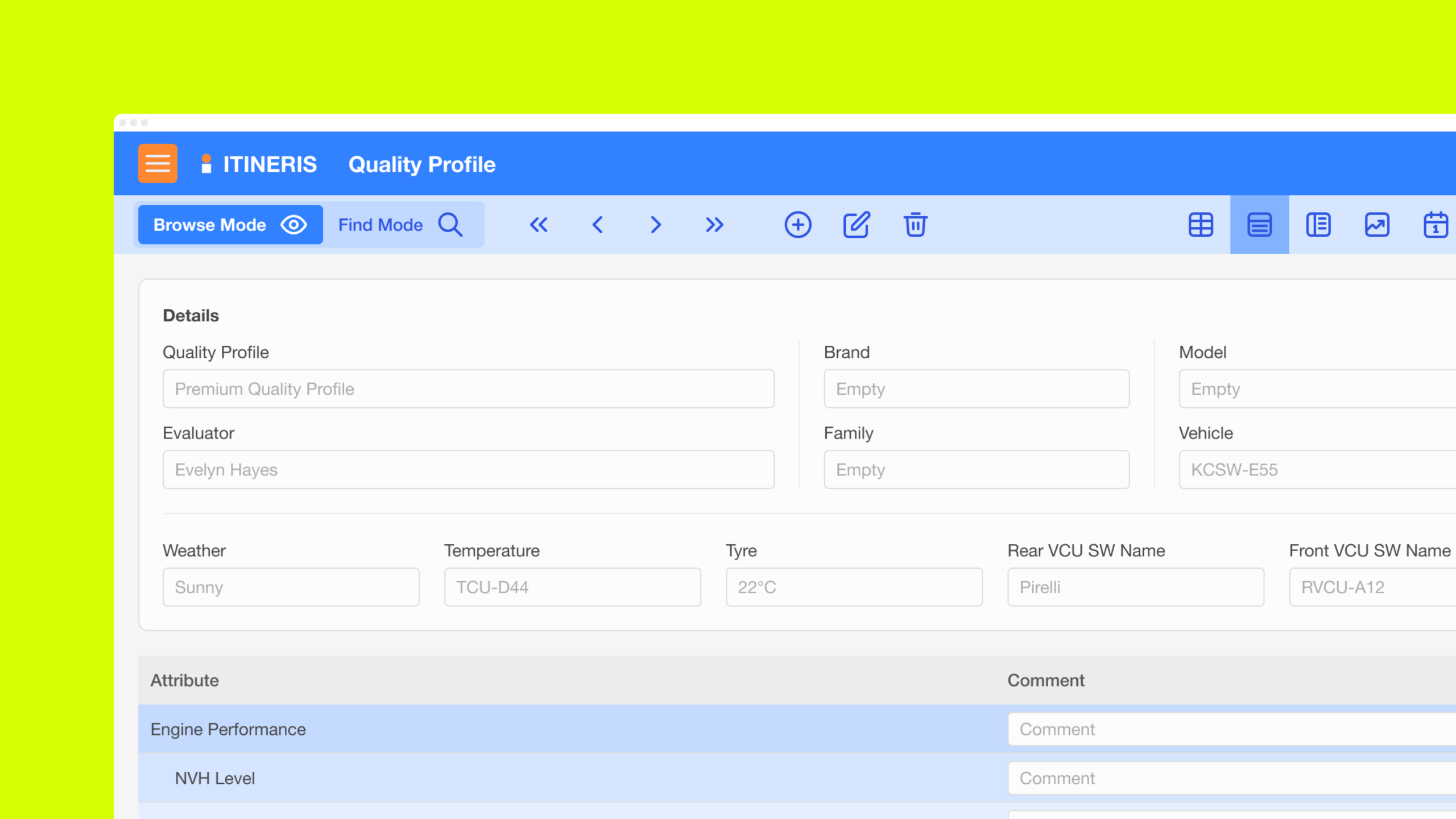
Key Features
1. Subjective Attribute Assessment:
- Logs detailed evaluations of Subjective Attributes, such as ride comfort, handling, steering feel, cabin noise, and interior aesthetics.
- Ensures all qualitative feedback is systematically documented for analysis.
2. Versatile Application Scenarios:
- Suitable for a wide range of use cases, including:
- Daily Testing: Capturing feedback from engineers and drivers during routine tests.
- Marketing Events: Assessing public perception during vehicle showcases or promotional drives.
- Customer Feedback Sessions: Gathering insights from real-world users for iterative improvement.
- Media Drive Experiences: Documenting feedback from journalists and automotive experts to refine marketing strategies.
3. Customizable Rating Scales:
- Allows evaluators to use tailored rating scales suited to specific scenarios or preferences, such as:
- Numerical scales (e.g., 1–10).
- Descriptive scales (e.g., Poor to Excellent).
- Star ratings (e.g., 1–5 stars).
4. Data Normalization:
- Automatically converts various rating scales into a standard numerical score behind the scenes, ensuring consistency across all evaluations.
- Normalized data enables reliable comparison and aggregation, even when assessments are conducted using different methods.
5. Evaluator-Specific Weighting:
- Assigns different weightings to scores based on the evaluator’s expertise and relevance.
- For example, feedback from professional test drivers may be weighted more heavily than general customer input, reflecting the specific context of the evaluation.
6. KPI Dashboards:
- Creates detailed Key Performance Indicator (KPI) dashboards that visualize subjective attribute performance.
- Dashboards provide actionable insights into strengths, weaknesses, and areas for improvement.
7. Integration with Other Modules:
- Links with Target Settings to align subjective attributes with predefined project goals.
- Works with the DVP to validate subjective attributes alongside objective testing metrics.
- Connects with the Issue Tracker to log and resolve deviations from desired subjective performance.

Benefits
- Holistic Vehicle Evaluation: Complements objective testing by capturing the emotional and sensory aspects of vehicle performance.
- Customer-Centric Design: Provides insights into how customers perceive the vehicle, guiding design refinements to enhance satisfaction and loyalty.
- Consistency in Feedback Analysis: Normalized scoring ensures fair and reliable comparisons across different evaluators and scenarios.
- Data-Driven Decision-Making: Detailed dashboards and reports offer actionable insights, enabling teams to prioritize improvements effectively.
- Improved Product Differentiation: Helps identify unique strengths and opportunities for differentiation based on subjective perceptions.
- Enhanced Collaboration: Provides a shared framework for engineers, designers, marketing teams, and decision-makers to align on product goals and strategies.
Applications
- Prototype Development: Evaluate subjective attributes during early design stages to ensure alignment with brand identity.
- Competitor Benchmarking: Assess how internal vehicles compare to competitors in terms of subjective appeal.
- Customer Insights: Use feedback from real-world users to fine-tune vehicle design and features.
- Media Strategy: Gather journalist feedback to refine vehicle positioning and highlight strengths during media events.
Example Scenario:
During the development of a new luxury sedan, the Quality Profiles module is used to evaluate ride comfort and cabin noise levels.
- Test Drivers: Professional drivers score the vehicle’s suspension and noise insulation on a 1–10 scale during testing.
- Customers: Potential buyers at a focus group rate the interior ambiance using a descriptive scale from “Poor” to “Excellent.”
- Normalization: These diverse ratings are converted into standardized numerical scores by the module, ensuring comparability.
- Dashboard Insights: A KPI dashboard highlights that while cabin noise levels score high, ride comfort is below target. This prompts the engineering team to adjust the suspension tuning, with subsequent iterations tracked using the same module.